No-Equipment Workouts

Lucas Schneider
| 26-06-2026
 · Sport Team
Sometimes the idea of going to a gym or buying specialized gear can feel overwhelming, but the truth is that your own body is a powerful tool for getting fit.
Whether you are short on time, working within a budget, or simply want to exercise in the comfort of your home, these no-equipment workouts can help you build strength, boost your heart rate, and improve your overall fitness without using any equipment.
Why Choose Bodyweight Training?
Bodyweight exercises are highly effective because they use your own body mass to create resistance. You can easily adjust the difficulty by changing your range of motion, speed, or stance. They also help improve balance, coordination, and flexibility.
Consistent bodyweight training can improve muscular endurance, increase strength, enhance functional fitness, and burn calories effectively when performed with appropriate intensity and progression. The key is to focus on proper form and gradually challenge yourself with more repetitions or more advanced exercise variations.
Full-Body Warm-Up
Before beginning the workout, spend about five minutes warming up. Try gentle neck rolls, shoulder circles, arm swings, leg swings, and torso twists. Then perform ten slow squats and ten light jumps to increase blood flow and prepare your muscles for exercise. Warming up helps reduce the risk of injury and improves movement quality throughout the workout.
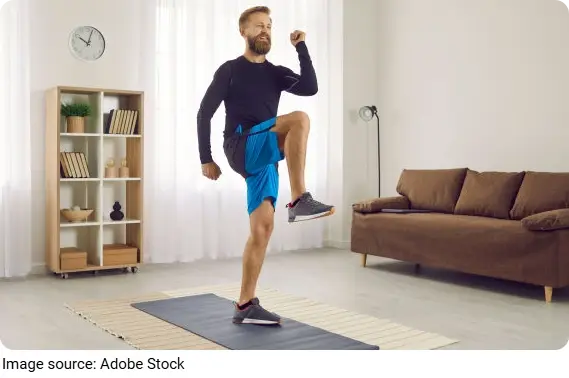
The Workout: Four Moves, No Equipment
This circuit combines strength and cardiovascular exercise. Perform each exercise for 45 seconds, then rest for 15 seconds before moving to the next. After completing all four exercises, rest for one minute. Repeat the circuit three times.
1. Squats
Stand with your feet hip-width apart and your toes slightly turned outward. Lower your hips back and down as though sitting into a chair while keeping your chest lifted and your knees aligned with your toes. Lower as far as is comfortable, then push through your heels to return to standing. For an added challenge, pause at the bottom of the squat for two seconds. Squats primarily strengthen your thighs, glutes, and core.
2. Push-Ups
Start in a plank position with your hands slightly wider than shoulder-width apart. Keep your body in a straight line from head to heels. Lower your chest toward the floor with your elbows at approximately a 45-degree angle to your torso, then press back up. If standard push-ups are too challenging, perform them on your knees or against a sturdy elevated surface. This exercise strengthens the chest, shoulders, triceps, and core.
3. Plank with Shoulder Tap
Begin in a high plank position with your arms fully extended. Keeping your hips as stable as possible, lift your right hand and tap your left shoulder before returning it to the floor. Repeat on the opposite side. Perform the movement slowly and with control to minimize body rotation. This exercise strengthens the core, shoulders, and arms.
4. Glute Bridges
Lie on your back with your knees bent, feet flat on the floor, and arms resting alongside your body. Press your hips upward until your body forms a straight line from your shoulders to your knees. Squeeze your glutes at the top before lowering slowly. For greater difficulty, hold the bridge for three seconds before lowering. This movement strengthens the glutes, hamstrings, and lower back.
Cool Down and Stretch
After completing your final round, spend two to five minutes cooling down by walking in place at a gentle pace. Then stretch your quadriceps, hamstrings, chest, and lower back, holding each stretch for 20 to 30 seconds without bouncing. Stretching may help maintain flexibility and contribute to overall comfort after exercise.
Tips for Success
Listen to your body and exercise at a comfortable intensity. Stay hydrated throughout your workout. Aim to complete this routine three to four times per week, gradually increasing either the exercise duration or the number of circuits as your fitness improves. For additional variety, you can include bodyweight exercises such as lunges, mountain climbers, or bicycle crunches.

You do not need a gym membership or expensive equipment to build strength and improve your fitness. Consistent bodyweight training provides an effective, convenient, and accessible way to stay active. By practicing proper technique, progressing gradually, and exercising regularly, you can support your long-term health while steadily improving your strength, endurance, and overall well-being. Every workout is a step toward a healthier and more active lifestyle.