Minimal Floral Art

Mason O'Donnell
| 22-04-2026
 · Plant Team
A single stem in a quiet room can sometimes say more than a table full of blooms.
Minimalist floral design is not about absence—it's about intention.
Every line, every color, every empty space is carefully considered. Instead of overwhelming the eye, it invites you to slow down and notice.
The Core Idea: Less, But Better
Minimalist floral art focuses on reduction. Instead of adding more elements, you remove anything unnecessary until only the essential remains.
This approach highlights the natural form of each flower. A curved stem, a subtle color gradient, or a single leaf becomes the focal point. There is no competition within the arrangement—only clarity.
The goal is not to impress through abundance, but to create impact through precision.
Choosing the Right Materials
In minimalist design, selection matters more than quantity. Every element must justify its presence.
Follow a simple selection principle:
1. One main flower — Acts as the visual anchor
2. One supporting element — Adds contrast or balance
3. One container — Clean, simple, and understated
Flowers with strong shapes—such as long stems or defined petals—work particularly well. Neutral or soft colors often enhance the minimalist effect, though a single bold color can also create striking contrast.
The Power of Empty Space
Empty space is not a gap; it is an active part of the design. In minimalist floral arrangements, space allows the eye to rest and gives each element room to stand out.
Avoid filling every area. Instead, let the arrangement “breathe.” A single stem leaning slightly to one side can feel more dynamic than a dense cluster.
Think of space as framing the flower rather than leaving something unfinished.
Line and Structure Matter
Minimalist floral art often emphasizes line over volume. The direction of a stem, the angle of a branch, or the curve of a leaf defines the composition.
Pay attention to:
1. Vertical lines — Create a sense of height and calm
2. Diagonal lines — Add movement and subtle tension
3. Asymmetry — Makes the arrangement feel natural and balanced
Perfect symmetry is rarely the goal. Instead, slight imbalance creates visual interest without feeling chaotic.
Containers as Part of the Design
In minimalist arrangements, the container is not just a holder—it is part of the composition.
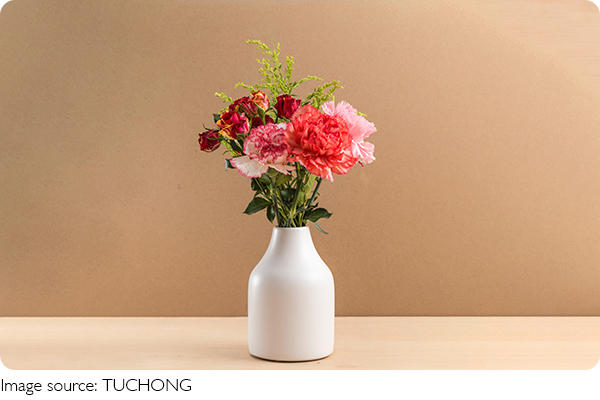
Choose containers with clean shapes and neutral tones. Glass, ceramic, or matte finishes work well. Avoid overly decorative designs that compete with the flowers.
The relationship between the container and the plant should feel harmonious. A tall, slender vase pairs well with long stems, while a low, wide container suits shorter compositions.
Placement Enhances the Effect
Minimalist floral arrangements rely heavily on their surroundings. Placement can either elevate or weaken the overall impact.
Consider these placement strategies:
1. Use uncluttered surfaces — Allows the arrangement to stand out
2. Position near natural light — Enhances subtle colors and shadows
3. Avoid crowded backgrounds — Maintains visual clarity
A minimalist arrangement needs space around it to fully express its character.
Maintaining Simplicity Over Time
Minimalism requires ongoing attention. As flowers change, the balance of the arrangement may shift.
Regularly remove any elements that no longer fit the composition. Replace a fading stem rather than adding more to compensate. The principle remains the same: keep only what contributes to the design.
This process is not about preserving perfection, but about maintaining intention.
In the end, minimalist floral art is a quiet discipline. It teaches you to see beauty in restraint and to appreciate the details often overlooked. By focusing on fewer elements, you begin to notice more—the curve of a stem, the space between forms, the subtle dialogue between color and light. And in that simplicity, the arrangement becomes not just decoration, but a thoughtful expression of balance and clarity.